
GitHub Discussions
Join the survey discussion
Ask questions, suggest papers, and discuss the taxonomy with the AI4SS community.
Open discussionsComprehensive survey · 2026
Huazhong University of Science and Technology
We organize social intelligence modeling as four organically connected stages—perception, understanding, generation, and simulation—forming a coherent path from observable social signals to evolving social systems. A searchable collection aligned with this taxonomy makes related work easier to locate across stages.
Community
Discuss the survey or find the current WeChat group entry.
GitHub Discussions
Ask questions, suggest papers, and discuss the taxonomy with the AI4SS community.
Open discussionsWeChat Group
Open the dedicated thread for joining information maintained by the AI4SS community.
View WeChat groupDefinition
AI has studied society for years, yet the field remains fragmented. Research on social intelligence appear in different areas such as sentiment analysis, misinformation detection, user modeling, content generation, multi-agent systems, and social simulation. Because these studies use different task names and keywords, it is difficult to see how they connect or to form a clear view of the field as a whole.
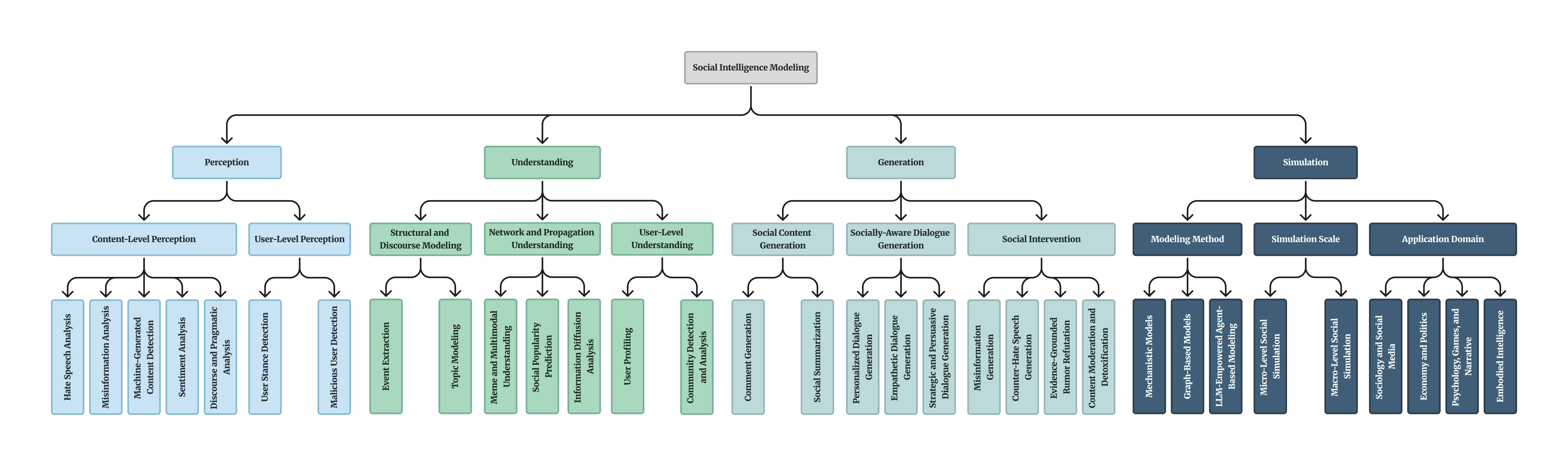
Our Social Intelligence Modeling (SIM) brings these fragments together in one framework. By organizing nearly 1,000 papers across 20+ tasks, we show how AI models social content, people, relations, and social evolution. SIM structures the field into four connected levels: Perception, Understanding, Generation, and Simulation, providing a unified view of how AI engages with social systems.
Recognize social signals and states in content, users, and multimodal interactions.
Model social structure, discourse, networks, communities, and behavioral patterns.
Produce socially situated content, dialogue, counter-speech, and interventions.
Reconstruct dynamic social processes and explore plausible collective futures.
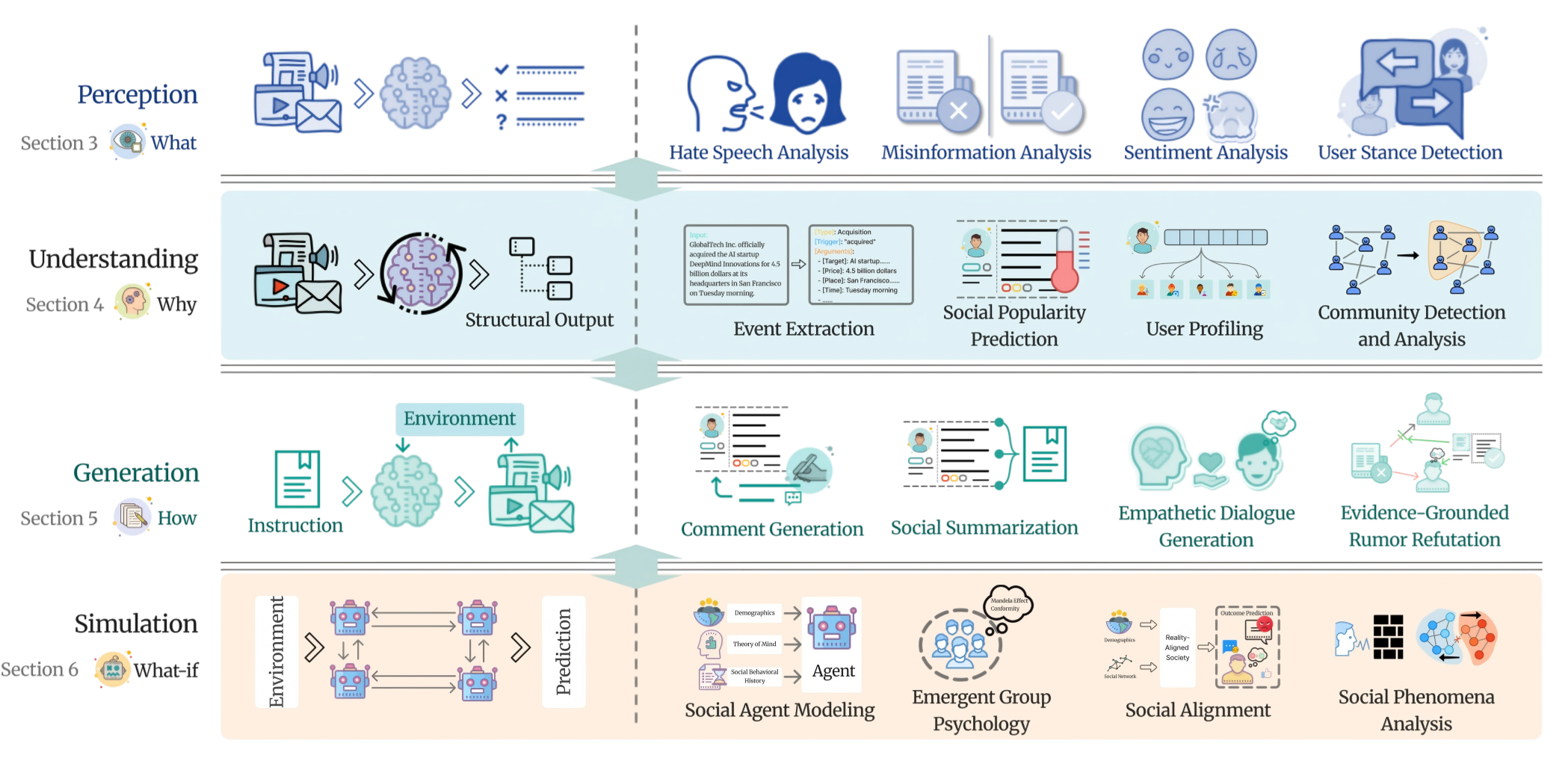
Taxonomy and statistics
Counts are generated from the selected survey database. Multi-category papers appear in every relevant task, while the headline total counts each paper once.
Chronological map
Each dot is one paper positioned by publication date. Rows correspond to the four survey fields; select a row, year, or paper to update the explorer.
Paper collection
Search by title, author, venue, task, abstract, or summary.
Browse all papersTry a broader task, remove the venue filter, or clear the search.
Paper submission
Submit structured metadata for review. A suggestion is added to the collection only after validation and maintainer approval.
Paste Zotero metadata or fill only the paper basics.
A maintainer checks scope, duplicates, and completes the taxonomy.
Accepted data updates the collection and website.
Summary
Abstract